
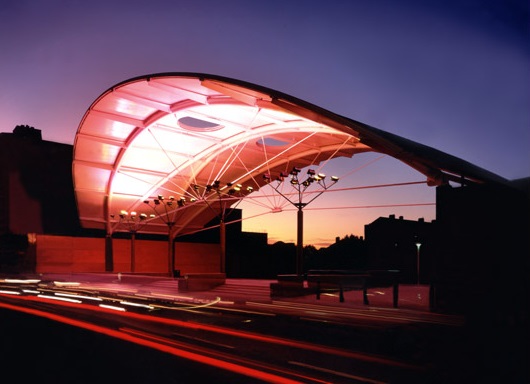
Peckham as a Palimpsest
Postmodernism was never just about style; it was about dismantling certainty and celebrating contradiction. In South London, Peckham has become a vivid stage for this inheritance. The now‑demolished Peckham Arch, built in the 1990s, was a civic gesture of postmodern playfulness: monumental yet ironic, a gateway that symbolised regeneration while mocking the solemnity of modernist purity. Its removal in 2025 sparked debate about the value of postmodern landmarks, reminding us how fragile cultural memory can be when confronted with redevelopment.
Today, the message continues in projects such as Peckham House by Surman Weston. Completed in 2024, the house embodies what critics have called “subversive contextualism”: monolithic in form yet witty in detail, crafted brickwork that both honours and subverts the eclectic fabric of Peckham. It is a building that refuses neutrality, layering irony and symbolism in ways that resonate with the fragmented narratives of digital culture.
The parallel with digital language is striking. Just as postmodern architecture plays with citation and contradiction, digital communication thrives on remix, memes and micro‑narratives. Both reject linear truth, both embrace plurality. Peckham’s urban fabric, with its mix of postmodern gestures and digital campaigns, becomes a palimpsest: a city where physical structures and virtual signs overlap, where architecture and communication share the same grammar of irony and fragmentation.
Art completes the dialogue. Postmodernism thrived on appropriation and collage; digital culture thrives on remix and infinite reproduction. Walter Benjamin’s lost aura is not only absence but possibility: in Peckham’s galleries and digital platforms, the work of art seeks presence, community and interaction rather than uniqueness.
South London, with Peckham at its heart, shows us that postmodernism is not a closed chapter but a living inheritance. The digital age has transformed its gestures, adding speed, algorithms and the risk of superficiality. Yet the challenge remains the same: to defend dignity in communication, art and architecture against the temptation to reduce everything to spectacle.
Postmodernism taught us that there is no single truth. The digital reminds us that plurality can collapse into noise. Peckham’s message is clear: fragments can still become culture, irony can still become presence, and architecture can still speak in the language of freedom.